The Horse Breeding Journey: A Step-by-Step Guide for First-Time Breeders
The Horse Breeding Journey: A Step-by-Step Guide for First-Time Breeders
You do not need to know everything about breeding a horse before you begin. You do need to know what comes next, which decisions are yours to make, and when to ask for help.
You can picture the foal so clearly: the first wobbly steps and the little face appearing beside your mare in the stable. What is harder to picture is everything between the moment you decide to breed and the moment that foal arrives.
When I planned my first foal, I could find information about individual parts of breeding. What I struggled to find was a way to put those parts in order and make them practical and useful. Where was I supposed to register the mare for breeding? Where did I find the list of stallions? Was I supposed to choose a stallion first? Talk to a vet? Find a breeding station? When should I prepare the foaling area, and what signs indicate foaling is near?
If your mind is full of questions like these, I know how you feel, and you're in the right place. This guide walks through the horse breeding process from the first decision to life with your foal. It is an overview, not a fixed calendar: your mare, your location, your breeding method, and your veterinarian's advice will shape the details.
What are the main stages of the horse breeding journey?
The breeding journey can be thought of as eight connected stages: deciding whether your mare is a suitable candidate, defining your breeding goal, choosing a stallion, planning the breeding with your veterinarian and breeding provider, confirming pregnancy, caring for the mare through gestation, preparing for foaling, and caring for the mare and foal after birth.
Decide why you want to breed and whether this mare is a suitable candidate.
Set a breeding goal and assess the mare's and prospective stallions' qualities.
Make a practical plan with your veterinarian and breeding provider.
Breed the mare and arrange pregnancy checks.
Care for her through pregnancy and prepare for foaling.
Know what to watch for during birth and the first days.
Care for the mare and foal after the birth.
Help your young horse develop through the months that follow.
These stages overlap. You might research stallions while talking to your vet or start preparing your facilities long before the mare is pregnant. The point is to see the whole journey before one exciting decision pulls all your attention toward it.
1. Start with the horse you hope to raise
Before you search for a stallion, ask yourself what you hope this foal will become. A future riding partner? A competition prospect? A horse you intend to sell? Then think about the job you want to give your horse: Dressage? Jumping? Working Equitation? Para riding? Riding school prospect? Or would you like to do multiple things? Then consider what matters in terms of temperament, soundness, athletic ability, trainability, and any other aspects that come to mind.
Now look carefully at your mare. What qualities would you be delighted to see in her foal? What concerns would you rather not reproduce? Consider her health, age, reproductive history, conformation, pedigree, temperament, and the life you can offer a young horse. Loving your mare is a meaningful reason to explore breeding. It also makes an honest assessment especially important.
A veterinarian can help assess your mare's general and reproductive health and decide whether a more detailed reproductive examination is appropriate. Depending on the mare and her history, that may include evaluating the reproductive tract with palpation and ultrasound, with additional tests as needed. AAEP notes that a reproductive examination may include assessment of the ovaries, uterus, cervix, vagina, vestibule, and perineum, with ultrasonography used where practical.
🤔THINK ABOUT
Your mare contributes half the foal’s genes, and she will also shape its earliest experiences. Choose a mare whose qualities you would be happy to see in your foal.
You do not have to settle the question alone. A veterinarian can help you assess reproductive health, while a knowledgeable breeder or breed society may help you think through your goal and your mare's strengths.
If you are still deciding whether to breed at all, start with Thinking About Breeding Your Mare? Here's Where to Start.
🙋 YOUR NEXT QUESTION
If the foal inherits traits you did not plan for, are you still prepared to care for the horse you have bred? It probably feels distant, but if you would need to sell the foal, think honestly about its likely market and your plan if a suitable home takes time to find.
2. Choose a stallion for the mare and your goal
Stallion browsing is one of the most enjoyable parts of the process. It is also easy to fall for a beautiful video before you have decided what you are looking for.
Compare candidates against your actual breeding goal. Look at health information and breed-relevant genetic testing where applicable, temperament, conformation, pedigree, performance, and, where available, their offspring. Think about what the stallion may add to the pairing and which qualities in your mare you want to preserve.
No combination guarantees a particular foal. Breeding decisions are about increasing the likelihood of certain qualities, not ordering a finished horse from a catalogue.
🤔 THINK ABOUT
Many breeding associations offer stallion advice. Assess the mare properly and honestly, tell them what you’re looking for in a foal, and let them present suitable options. Many stallions also have offspring groups on social media; join them, look at different offspring, and ask owners what they have experienced.
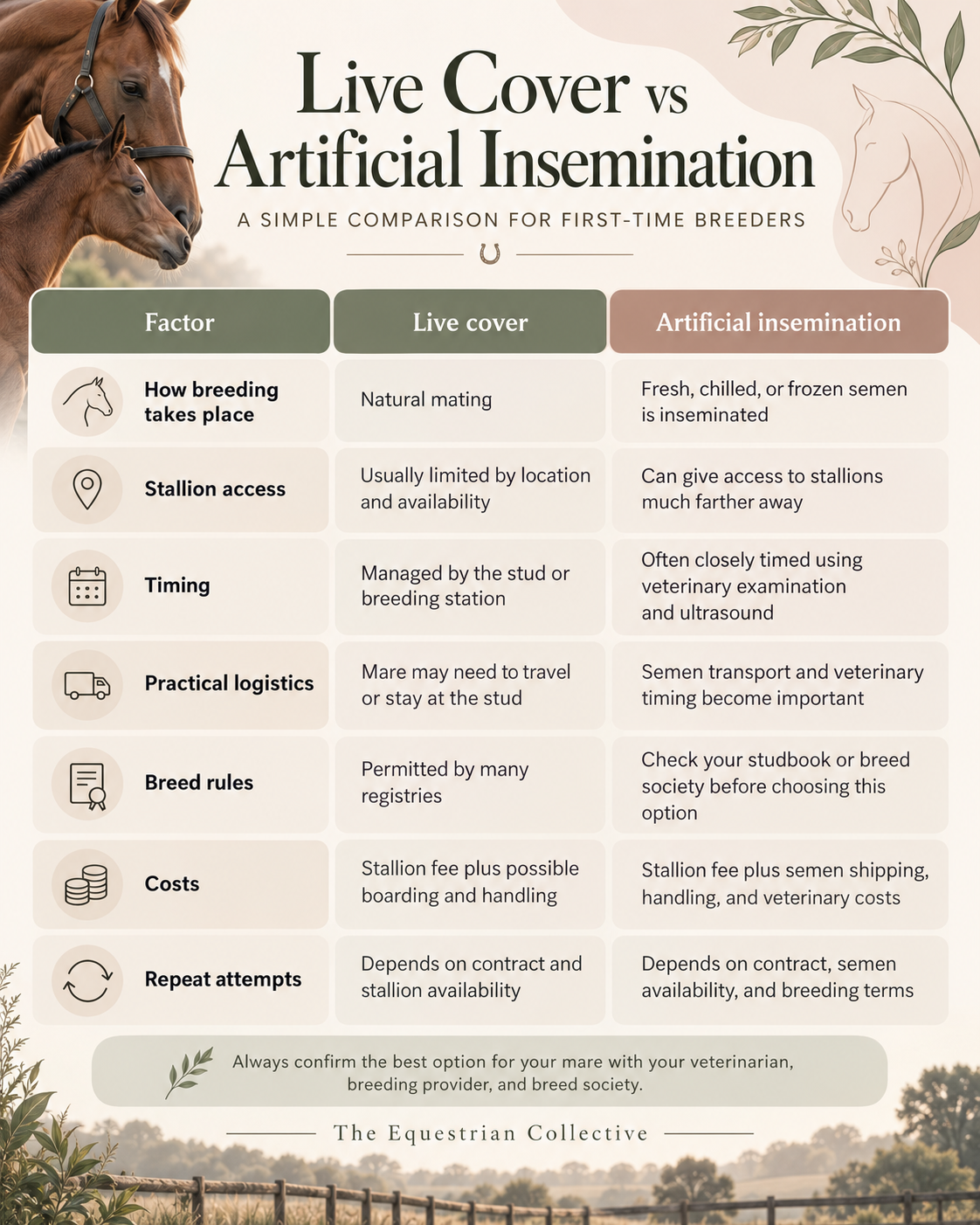
The practical terms matter too. Ask about the availability and type of semen or live cover, where breeding takes place, fees, shipping arrangements, paperwork, and what happens if your mare does not conceive on the first attempt. Breed societies and studbooks may have their own registration requirements, so check these before committing.
🙋 YOUR NEXT QUESTION
Can you explain why this stallion is a good match for your mare in a few clear sentences? If the answer is mostly about how impressive the stallion is, rather than how the pairing works, keep digging.
3. Make the breeding plan with the people who will help you
Your veterinarian and breeding provider can help turn an idea into a workable plan. Depending on the mare and the breeding method, that may involve discussing her reproductive history, health examinations, timing within her cycle, transport, semen arrangements, and follow-up appointments.
The details vary. There is no single schedule that fits every mare.
🤔 THINK ABOUT
This is a good moment to keep the practical pieces together: contact details, contracts, the stallion's terms, veterinary notes, dates, invoices, and questions you want answered. It is far easier to stay calm when you can find the information you need.
Also consider the life around the breeding appointments. Who will transport the mare if needed? Who looks after her if you are away? What are the alternatives if the first attempt does not result in a pregnancy? A plan does not remove uncertainty, but it gives you somewhere to begin when plans change.
🙋YOUR NEXT QUESTION
Who is responsible for each appointment, decision, and piece of paperwork?
4. How does breeding work, and when can you confirm pregnancy?
Breeding may take place through natural cover or artificial insemination, depending on the stallion, the mare, the breeding provider, breed rules, and your location. Your veterinary team will advise on timing and care for your situation.
Transrectal ultrasound is commonly used for early pregnancy diagnosis. Merck describes one commonly used schedule as an examination around days 14–18 to identify pregnancy and twins, followed by another around days 25–30 to assess development. The exact schedule varies between breeding programs and individual mares. In Sweden, for example, we usually do ultrasound at around 17, 45, and 90 days.
Do not assume that one successful insemination means you can move straight to planning a due date. Equally, if your mare is not pregnant, it does not mean your entire dream is over. Ask what the findings mean and what your options are.
🤔 THINK ABOUT
Investigate the opportunity to leave your mare at the breeding provider until confirmed pregnant. They may have several mares on site and facilities specifically set up for reproductive management. Ask exactly what is included: care, monitoring, pregnancy checks, turnout, transport arrangements, and fees.
This part can feel unexpectedly emotional. You may have spent weeks preparing for a result you cannot control. Keep asking questions, give yourself room to feel disappointed if things do not go to plan, and let the next decision be guided by what you have learned about your mare.
🙋 YOUR NEXT QUESTIONS
When are the recommended pregnancy checks, and whom should you call if you have a concern between them? And if your mare doesn’t get pregnant, what is Plan B?
5. Care for your mare through pregnancy
Once pregnancy is confirmed, the pace may feel slower. That does not mean nothing is happening. Horse pregnancies average around 340 days, but foaling dates naturally vary, so treat the estimated date as a planning window rather than an appointment your mare has agreed to keep.
Your mare needs a care plan that changes with her needs. Discuss feeding and body condition, turnout and exercise, routine health care, vaccinations, and any concerns with your veterinarian and, when useful, an equine nutrition professional. Avoid making major changes based on a generic month-by-month chart alone.
Vaccination planning is one area worth discussing early. AAEP recommends that previously vaccinated broodmares receive certain vaccinations around four to six weeks before foaling to help increase antibody concentrations in colostrum, but the exact vaccination program should be determined with your veterinarian according to the mare, disease risk, location, and vaccine history.
🤔 THINK ABOUT
Never be afraid to ask questions. No one expects you to know everything, and you shouldn’t put that pressure on yourself. In my experience, people are happy to help.
Use the months ahead to learn, prepare your facilities, and make sure you know how to reach veterinary help. Keep records of appointments and advice so you can see what has been done and what comes next.
It is possible to feel both thrilled and strangely impatient during this stage. You are doing real work even when the most visible thing happening is your mare quietly eating her hay.
🙋 YOUR NEXT QUESTION
What care needs to be reviewed as pregnancy progresses, and when should you contact your vet?
6. Prepare for foaling before you need the plan
As foaling approaches, prepare a clean, safe, calm, and comfortable place for your mare and a way to observe her that suits your facilities. Ask your veterinarian what supplies you should have ready, which signs to watch for, and when to call urgently.
Write down the emergency number and make sure anyone helping you knows where to find it.
🤔 THINK ABOUT
Install cameras looking out into the field and in the box, and connect them to your phone if that works for your setup. Being able to check your mare without constantly disturbing her can make those final nights considerably easier. Watch for changes in her usual behavior and physical signs as foaling approaches, but remember that mares do not all follow the same script.
Think beyond the birth itself too. Where will mare and foal live afterward? Is the turnout safe for a small foal? Are fences and gateways suitable? Who can step in if you are away or exhausted? Making these arrangements early gives you more space to be present when the time comes.
No checklist can predict exactly how a foaling will unfold. Its value is that you will not be trying to remember an emergency phone number or find a clean towel at two in the morning.
🙋 YOUR NEXT QUESTION
Could someone else find your supplies and call the veterinarian if you needed help? If the answer is no, your plan probably needs one more round of preparation.
7. Welcome the foal, then pay attention to the first hours
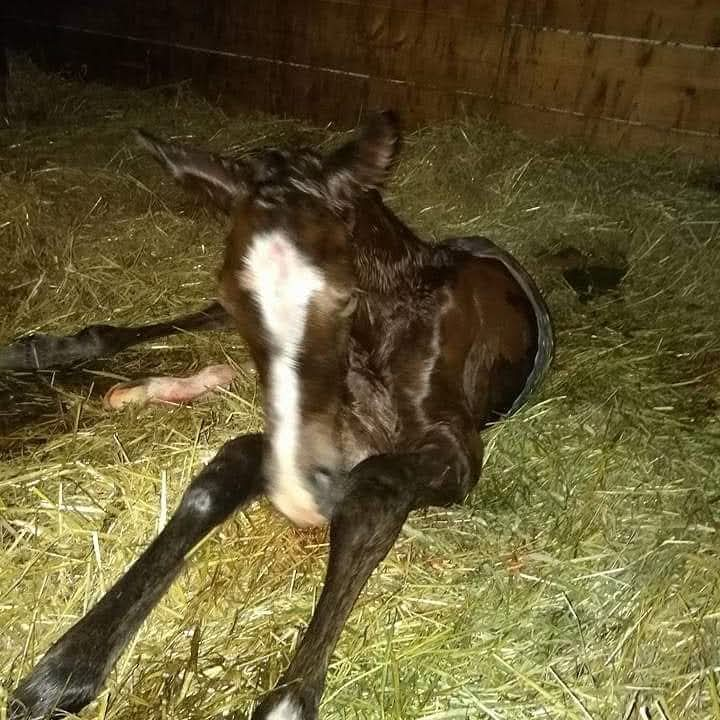
There is a moment after the birth when you may simply want to cry of happiness, become completely in love, and just stand still and look.
Take it.
Enjoy it.
Embrace it.
Then return to the plan you made with your veterinarian.
The first hours matter for both mare and foal.
The foal should stand within 1 hour.
The foal should nurse within 2 hours.
By around 3 hours, the foal should have passed meconium and the mare should have passed the placenta.
If these milestones are not happening as expected, contact your veterinarian.
Colostrum, the mare's first milk, is especially important because it provides the antibodies the newborn foal needs for early immune protection. AAEP emphasizes successful passive transfer of these antibodies, and Merck notes that antibody absorption from colostrum occurs during the first day of life.
Arrange the newborn examination your veterinarian recommends. A complete veterinary examination at around 12-24 hours of age, including assessment of IgG status, is ideal for a normal foal.
🤔 THINK ABOUT
If the birth seems abnormal, the foal is struggling, nursing is delayed, the placenta has not passed as expected, or you are concerned about either horse, contact your veterinarian promptly rather than trying to solve the problem from an article.
This is a time for attentive care, not a test of how much you can manage on your own. The most prepared breeder is often the one who knows when to make the call.
🙋 YOUR NEXT QUESTION
Do you know what your veterinarian wants you to observe and record during the first hours?
8. The breeding journey does not end at birth
The foaling is a beginning. In the following months, your foal will grow, learn from its mother and other horses, discover people, and gradually become more independent. You will make decisions about veterinary care, feeding, turnout, handling, registration, and eventually weaning. The timing and approach should fit the mare, the foal, and your circumstances.
🤔 THINK ABOUT
Some mares are very protective of their foals, especially at first. Give mare and foal space to settle, and respect their boundaries. When you introduce them to other horses, choose a safe setup, take it gradually, and watch how everyone responds. Ask an experienced breeder for guidance if you’re unsure.
Go slowly enough to notice the individual in front of you. A young foal does not need to master a long list of exercises. Gentle, appropriate interactions and good everyday care give you a foundation to build on. When weaning approaches, plan it with the foal's health, social needs, diet, and living situation in mind.
And somewhere in the middle of all those ordinary days, you may look at your foal and recognise a little of your mare, a little of the stallion you chose, and quite a lot that belongs only to this new horse.
Your first step should not be a big one
If the journey feels exciting, but also a little daunting, you are seeing it clearly. You are making decisions about a living horse, not following a recipe.
Start by writing down your goal, what you know about your mare, and the questions you want to ask before breeding. The free Breeding Journey Workbook gives you a place to gather those thoughts and start shaping a plan you can actually use.
You do not need to see every step from here. You just need to know which one comes next.
Frequently asked questions about breeding a horse for the first time
What should I do before choosing a stallion?
Start with your breeding goal and an honest assessment of the mare. Think about her health, temperament, conformation, pedigree, performance, and the qualities you would and would not want repeated in a foal. Then use those criteria when comparing stallions.
When should a mare be checked for pregnancy?
The exact schedule should be set with your veterinarian. One commonly used approach is an early ultrasound around days 14–18 after ovulation, when pregnancy and twins may be identified, followed by another examination around days 25–30 to assess normal development. Sometimes, a final check is made around 90 days.
How long is a mare pregnant?
Average gestation is about 340 days, although individual mares vary. An estimated foaling date should therefore be treated as a window for planning rather than a precise deadline.
What is the 1-2-3 rule after foaling?
It is a simple way to remember three important early milestones: the foal should stand within one hour, nurse within two hours, and within around three hours the foal should have passed meconium and the mare should have passed the placenta.
What should I prepare before foaling?
Have a clean and safe foaling area, veterinary contact information, basic foaling supplies, a way to monitor the mare, and a plan for what to do if something does not look right. Discuss your specific foaling kit and emergency plan with your veterinarian before you need them.
Do I need to know everything before breeding my mare?
No.
You do need to understand the major decisions ahead, know where to find reliable help, and be willing to ask questions when you do not know the answer.
That is what preparation is really for.
Camilla is a horse owner and breeder who knows what it feels like to plan a first foal with equal parts excitement and questions. She founded The Equestrian Collective to give first-time breeders the practical guidance, workbooks, and checklists she wished she had when she started her own breeding journey.