Thinking about Breeding your Mare? Here's where to start.
Thinking About Breeding Your Mare? Here’s Where to Start
Maybe you’ve looked at your mare and thought, I would love to have a foal from her someday.
It is an exciting thought, one that is usually followed by butterflies in the stomach. A foal from a mare you know and love, with carefully chosen qualities from a stallion you admire, can feel incredibly special.
And then “someday” suddenly starts to become a little more real.
You start looking at stallions. You read about insemination. Someone mentions chilled semen, another person talks about frozen semen, and suddenly there are breeding stations, pregnancy scans, stud fees, foaling preparations, and approximately 47 browser tabs involved in what originally felt like one fairly simple idea. The overwhelm is a fact.
I know that feeling.
When I decided to breed, I was convinced that all the information I needed would be relatively easy to find. Most of it was, but far from everything. The difficult part was understanding what I needed to know, what mattered at each stage, and what I should actually do next. It’s difficult to ask questions when you don’t know what to ask.
That experience is one of the reasons The Equestrian Collective exists today.
If you are considering breeding for the first time, you do not need to understand every detail before you begin. You do, however, need to ask some important questions before you commit to a stallion, a breeding station, or the very real responsibility of bringing a new horse into the world.
So before we get anywhere near stallion browsing, let’s start with the horse you already have and the reason you are considering this journey in the first place.
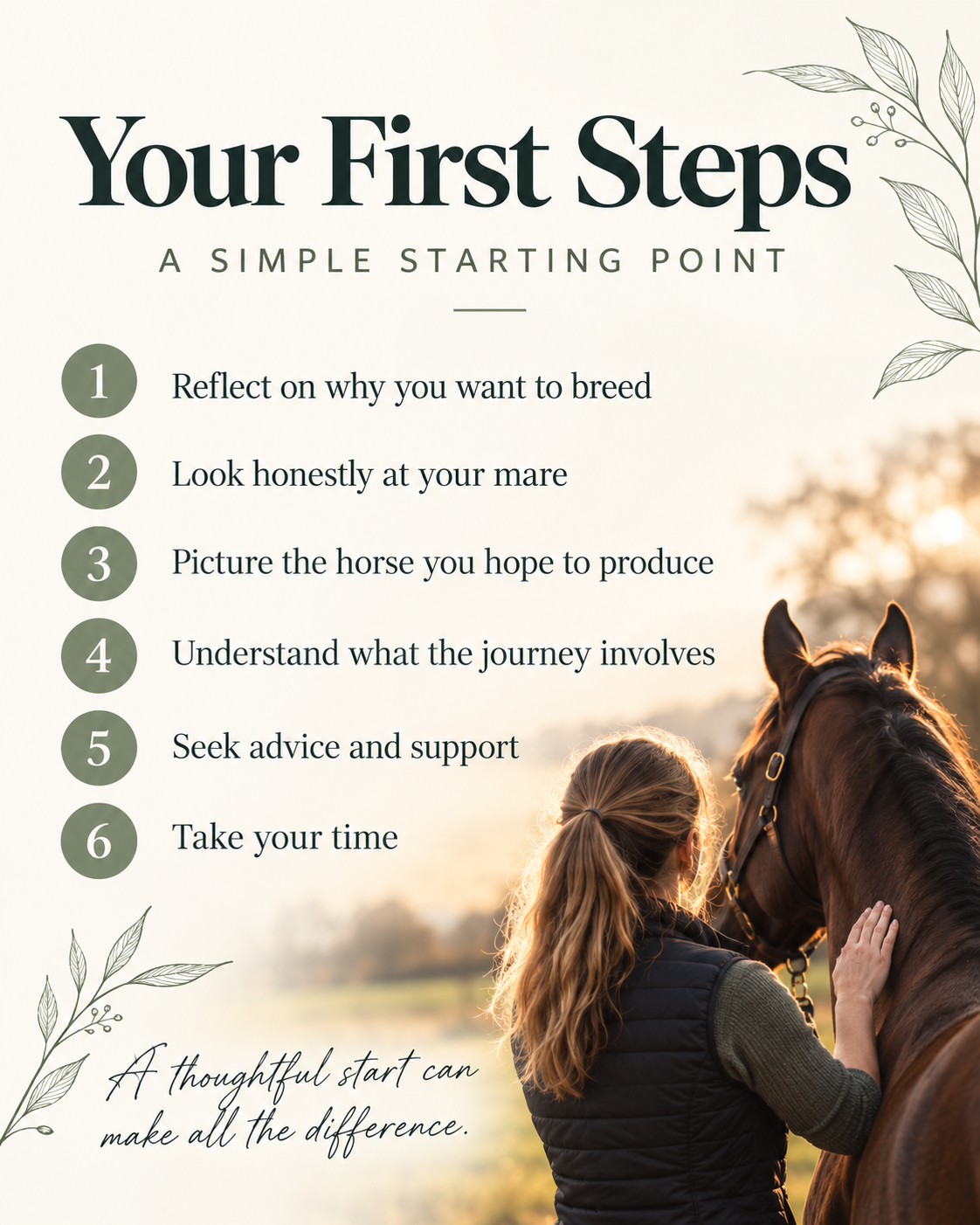
1. Start with why you want to breed
Before asking which stallion, ask yourself a much more important question:
Why do I want to breed this foal?
There are plenty of good reasons.
Perhaps you hope to breed your next riding or competition horse. Maybe your mare has qualities you particularly value and would love to preserve. You may have become fascinated by breeding itself, or perhaps there is something deeply meaningful about the idea of raising a foal from a mare who already means a great deal to you.
Whatever your reason, try to put it into words.
It sounds simple, but having a clear breeding goal will influence many of the decisions that come later, including the type of stallion you look for, the qualities you prioritise, and even how you evaluate whether breeding this particular mare makes sense.
Loving your mare (if you have one) is a wonderful starting point. It isn’t the whole breeding plan.
Many people considering breeding are doing so partly because they love something about the mare.
Maybe she has an incredible work ethic. Perhaps she is brave, kind, athletic, or wonderfully easy to live with. Maybe she is the horse you trust more than any other.
And yes, it is perfectly natural to imagine a smaller version of her running around the field.
Unfortunately, genetics does not offer a convenient “one more exactly like this, please” button.
A foal receives genetic material from both mare and stallion, and inheritance does not work by simply averaging the two horses. Add individual variation, development, environment, and upbringing, and there are no guarantees that the resulting horse will become exactly what you pictured.
That uncertainty is part of breeding.
It is also why a useful breeding goal goes beyond:
I want a foal.
Try instead:
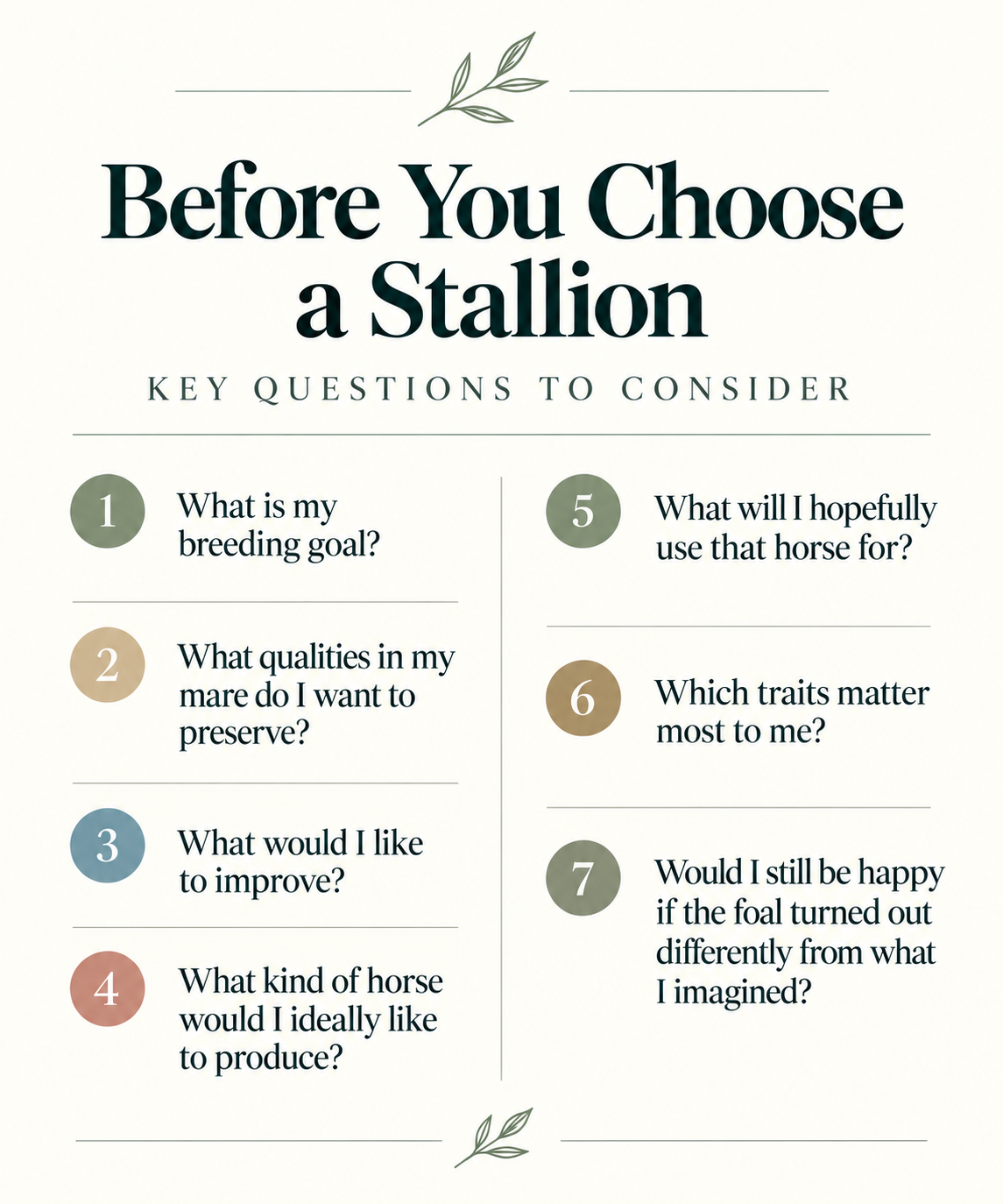
What qualities in my mare do I particularly want to preserve?
What kind of horse would I ideally like the foal to become?
What will I hopefully use that horse for?
Which traits matter most to me?
Would I still be happy with my decision if the foal turned out quite differently from the horse I imagined?
That last question matters.
Because ultimately you are not breeding a foal-shaped dream for next spring. You are breeding a horse whom you might want to sell, or keep for its whole life.
The fluffy ears are just the opening act.
2. Look honestly at the mare you have
Once you know why you want to breed, the next question becomes more personal:
Is this particular mare a good candidate for breeding?
This can be surprisingly difficult to answer objectively when you know your mare inside out.
The quirks that might make another person hesitate are often the very things you have learned to manage, understand, or even find endearing. That is part of having a relationship with a horse.
Breeding asks us to put that affection to one side for a moment and look at the mare differently.
Look at the whole mare, not one favourite quality
Your assessment might include:
her general health
age and reproductive history
conformation
soundness and previous health issues
pedigree and known hereditary concerns
temperament
performance or ridden qualities
strengths you would like to preserve
characteristics you would prefer not to reproduce
Some aspects should also be discussed with your veterinarian or reproductive specialist.
Depending on your mare’s age, history, and circumstances, a reproductive examination may be appropriate before you invest too heavily in the rest of the plan.
In other words, this is not a decision you need to make alone at the kitchen table with a pedigree database open beside you.
Temperament deserves more attention than it sometimes gets
Movement is exciting.
Pedigrees are fascinating.
Conformation matters.
But temperament should be part of the conversation too.
A useful question to ask yourself is:
If my foal inherited many of my mare’s characteristics, would I be happy with that outcome?
If the answer is no, it deserves serious thought before breeding.
A mare who is difficult to ride is not automatically unsuitable for breeding. There can be countless reasons why a horse becomes difficult under saddle, including pain, previous experiences, unsuitable training, or simply a mismatch between horse and rider.
But breeding should not become a convenient alternative simply because a mare cannot be ridden.
If she is consistently aggressive, extremely fearful, or very difficult to handle because of her underlying temperament, rather than a treatable physical or environmental problem, that is something worth considering carefully.
Your mare contributes genetically to her foal, but her influence does not stop at conception. She will also become her foal’s first social model.
Foals learn from their mothers. They watch how the mare responds to people, unfamiliar situations, and the environment around them. That does not mean a nervous mare will automatically produce a nervous foal, or that temperament comes entirely from the mother. Genetics, learning, environment and the individual horse all play a role.
But your mare is doing much more than carrying the pregnancy.
She is helping shape the foal’s first experience of the world.
Love your mare. Assess her anyway.
There is something slightly uncomfortable about making a list of your horse’s weaknesses.
I understand that.
But good breeding decisions depend on being able to see both sides.
Perhaps your mare has the kindest temperament you could ask for but a conformational weakness you would prefer not to reinforce. Maybe she is exceptionally athletic but hotter than you would ideally want in your future riding horse. Or perhaps she has exactly the temperament, type, and qualities you would happily have again.
That information becomes incredibly valuable later, because the goal will not simply be to find an impressive stallion. It will be to find a stallion who makes sense for this mare and for the horse you hope to breed. And that is a very different question.
3. Picture the horse you hope to produce
Once you have looked honestly at your mare, the next step is to think beyond the pregnancy, beyond the foaling, and even beyond the incredibly appealing little creature you hope will be running around the field next year.
What kind of horse are you actually hoping to breed?
This is where your breeding goal starts to become more specific.
Try to picture the horse a few years from now. What would you ideally like that horse to be like?
Perhaps you want to breed your future dressage horse, jumper, eventer, or an allround riding horse. Maybe your priority is a kind, sensible horse you can enjoy for many years. You might have ambitions to compete, or perhaps trainability and temperament matter far more to you than performance potential.
Think about things such as:
intended use
temperament
size and type
athletic ability
movement or jumping qualities
trainability
conformation
qualities from the mare you want to preserve
areas where you would ideally like the stallion to complement her
SWB encourages breeders to begin with two very simple but important questions: What is my breeding goal? And does my mare fit that goal? Their breeding advisory service then uses information about the mare, the purpose of the future foal, and other relevant details to suggest potentially suitable stallions.
That distinction matters.
You are not really looking for the best stallion.
You are looking for a stallion who makes sense for your mare, your breeding goal, and the horse you hope this particular combination might produce.
Don’t focus only on what you want to improve
When we start analysing a mare, it is easy to create a shopping list of things we would like to change. Perhaps you would like a little more height. More scope. Better movement. A calmer temperament. More athletic ability.
But breeding is not simply a process of correcting faults. Think just as carefully about the qualities you absolutely do not want to lose.
If your mare is exceptionally kind, willing, or easy to train, that may be far more valuable to you than gaining a little more spectacular movement. If she is brave and careful over fences, perhaps those are characteristics you would love to see carried forward.
Ask yourself:
If I could keep only three of my mare’s qualities in the foal, which three would I choose?
That question can be surprisingly useful.
It forces you to separate what you genuinely value from the things that simply look impressive on paper.
SWB’s breeding indices are built around a similar idea. Their descriptive indices are not intended to create one universal “perfect” horse. Instead, they help breeders understand how stallions are expected to pass on specific traits and can be used to identify stallions that strengthen or complement the mare’s characteristics.
Be realistic about genetics
This is also where expectations need to stay grounded.
If your mare has a particular weakness, choosing a stallion at the complete opposite extreme does not mean the foal will politely land somewhere in the middle.
Breeding is simply not that tidy.
So rather than thinking:
My mare lacks X, therefore I need the stallion with the most X I can possibly find.
it is usually more helpful to think:
Which stallion appears to complement my mare while still fitting the overall type and temperament I am trying to produce?
There is a little less shopping-list logic involved and considerably more matchmaking.
And yes, you can absolutely start browsing stallions while you are still working all of this out.
In fact, I think you should.
Looking at stallions is exciting. It can also help you learn what is available, understand different bloodlines, and begin recognising the characteristics that appeal to you.
Read this article on how to choose a stallion for your mare, and download the stallion comparison pack for free.
Just remember that browsing and choosing are two different stages.
The final decision should come after you have evaluated the mare and stallion together, rather than falling in love with a beautiful stallion video and trying to make the rest of the plan fit around him.
Depending on your breed and where you live, your breed society or studbook may also be a valuable source of guidance. SWB, for example, offers breeding advice based on information about the mare and the breeder’s goals, while making it clear that the final choice remains with the breeder.
For now, though, you do not need to choose anyone. You just need a clearer picture of what you are hoping to create.
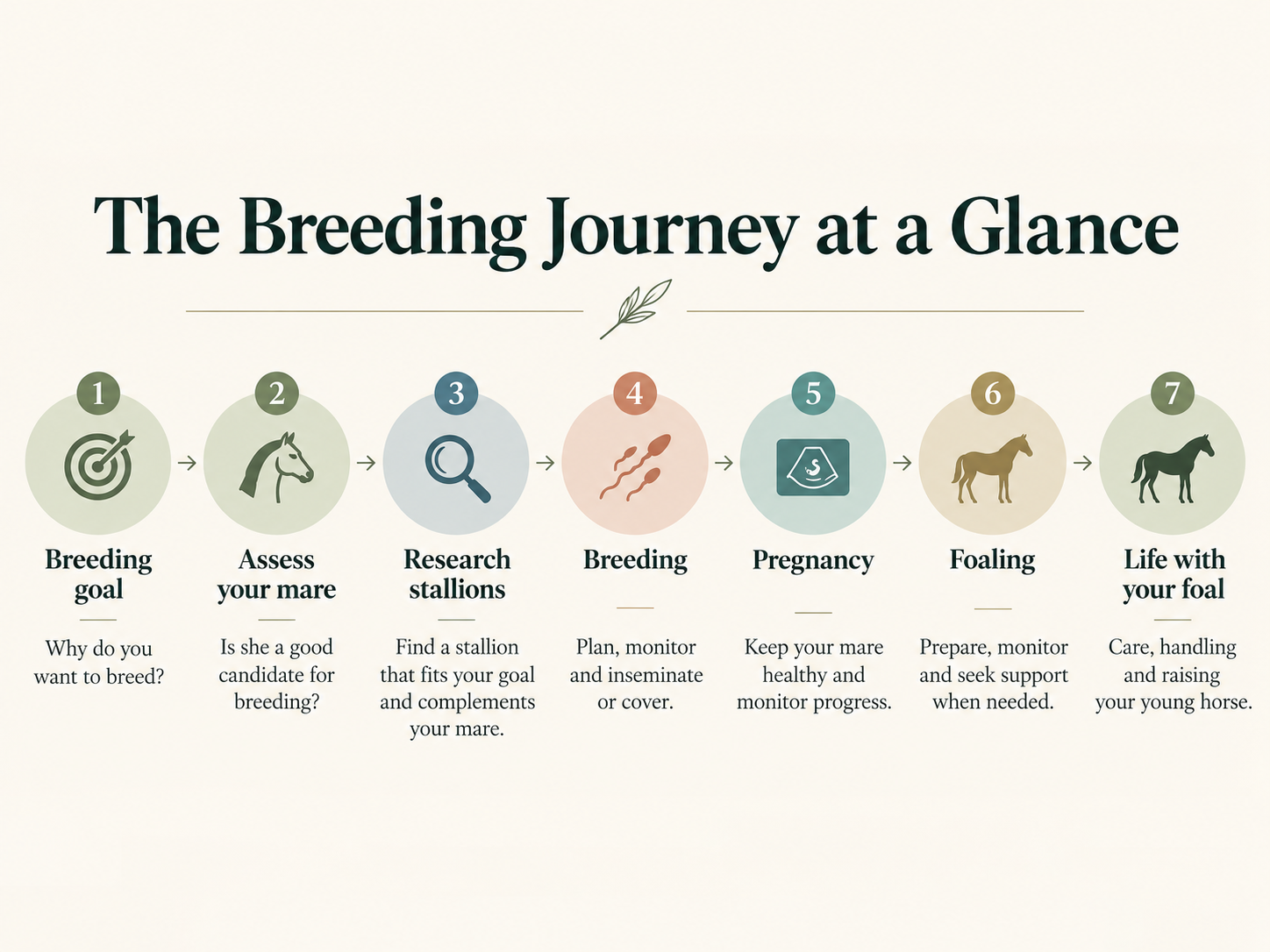
4. Understand what the breeding journey actually involves
One of the things that surprised me when I first started learning about breeding was how many stages there actually were.
From the outside, the process can sound wonderfully straightforward:
Choose stallion. Breed mare. Wait. Meet foal.
There is, unsurprisingly, a little more paperwork from Mother Nature.
A typical breeding journey may involve:
deciding whether breeding is right for you and your mare
assessing the mare and discussing her reproductive health
defining your breeding goal
researching and choosing a suitable stallion
deciding how and where the mare will be bred
monitoring her reproductive cycle
insemination or covering
pregnancy checks
caring for the mare throughout pregnancy
preparing for foaling
monitoring and assisting around the birth when necessary
caring for the mare and newborn foal
raising, handling, and eventually weaning the young horse
You do not need to become an expert in all thirteen of those things today.
But seeing the whole journey helps put the decisions you are making now into perspective.
US extension guidance takes a similarly broad view. Penn State encourages prospective breeders to think not only about stallion selection, but also about preparing the mare, choosing appropriate veterinary support, and making sure the farm setup is suitable for a foal before breeding begins.
Oklahoma State University also emphasises that mare owners benefit from understanding the reproductive process, whether they manage breeding themselves or send the mare to a specialist breeding facility.
Getting the mare pregnant is only one stage
It is very easy to let the first part of breeding consume all your attention.
Which stallion?
Fresh, chilled, or frozen semen?
Which breeding station?
When is she cycling?
When is the scan?
Is she pregnant?
Those are important questions, of course. But they are the beginning rather than the finish line.
Once your mare is confirmed in foal, there is a long period of care and preparation ahead, followed by the birth itself and then the very real responsibility of caring for both mare and foal.
The practical side may include reproductive monitoring, pregnancy checks, nutrition and routine healthcare, preparing a safe foaling environment, and learning what normal foaling looks like so you can recognise when something may need professional attention.
And once the foal arrives, a completely new stage begins.
The foaling may be the dramatic headline, but it is not the end of the story.
It is the first page of life with your young horse.
5. Ask yourself what you need before taking the next step
Now that you can see more of the journey, how does it feel?
Perhaps you’re even more excited than before. Perhaps you’ve realised there are a few things you need to learn or arrange first. Both are useful discoveries.
Being ready to breed does not mean having every answer today. It means being willing to look beyond the excitement and ask what you and your mare will need along the way.
Are there questions about your mare’s health or reproductive history that you want to discuss with your veterinarian?
Do you have the time and support to care for her through breeding, pregnancy, foaling, and the months that follow?
Where will your mare and foal live, and who could help if plans change?
What do you still need to learn before you feel comfortable making a decision?
Can you picture a future for the foal even if it grows into a different horse from the one you imagine?
You may not have clear answers to all of these yet. That is okay. Write down the questions that matter most to you and let them guide your next steps. A thoughtful pause now can make the journey ahead feel much less overwhelming.
Think beyond the due date
Responsible breeding extends far beyond producing a live foal. The early decisions you make affect the mare during pregnancy, the foal during its first months, and ultimately the young horse it becomes.
You do not need detailed answers to all of those questions before you begin.
But you should be willing to think about them.
Because when you decide to breed, you might not only commit to one exciting breeding season.
You might be starting a journey that will shape the next several years of your life, and potentially the entire life of the horse you bring into the world.
That can sound rather serious.
It is.
But it is also part of what makes breeding so extraordinary.
There are few things in the horse world quite like making a thoughtful decision today and, years later, looking at the horse standing in front of you and recognising pieces of the choices you made before that horse even existed.
If you’d like to see how the stages fit together, read my guide to the horse breeding journey for first-time breeders. It takes you from your first plans through pregnancy, foaling, and life with your young foal.
Your next step: put your thoughts on paper
If this article has left you with both excitement and a longer list of questions, you’re in good company. That is often what the beginning of a breeding journey feels like.
The free Breeding Journey Workbook gives you a place to explore your breeding goal, think about your mare, and start organising the decisions ahead. You can work through it at your own pace, whether you’re close to making a decision or simply wondering what might be possible.
Click here to download your free Breeding Journey Workbook