How to Wean a Foal: A Guide to Making Separation Easier
How to Wean a Foal: A Guide to Making Separation Easier
Your foal is growing up, becoming more independent and discovering that there's a whole world beyond her mother's side. But how do you know when she's ready for weaning, and how can you make the transition as gentle as possible? Let's look at what the research tells us, what you can do to prepare, and what I learned from raising Disa.
There comes a moment when you look at your foal and realise that the tiny, wobbly creature who once followed her mother everywhere is turning into a confident young horse with opinions of her own.
She's eating hay, playing in the field, and becoming increasingly interested in everything around her. Sometimes, she barely seems to notice where her mother is.
And then you start thinking about weaning.
I think weaning is one of those milestones that deserves more thought than it sometimes receives. After all, we're asking a foal to adjust to a pretty significant change in her life. And we're asking her mother to do the same.
The good news is that there are things we can do to prepare them.
Research has explored how different weaning methods affect mare and foal, and some findings are particularly interesting. Gradual separation, familiar surroundings, and the presence of other horses can all play an important role.
But perhaps the most important lesson is that there isn't one perfect weaning recipe.
Gentle weaning starts with understanding your foal, preparing well in advance, and making sure she has the security of other horses around her when her mother is no longer there.
Let's start with the question almost everyone asks first.
When should you wean a foal?
If you've asked a few breeders this question, you may already have noticed something: the answers aren't always the same.
Four months. Six months. Eight months. Let it happen naturally.
Everyone seems to have a preferred age, usually supported by years of experience and, occasionally, a very firm opinion.
So who's right?
Personally, I think six months is the minimum age for weaning. However, many domestic foals are weaned somewhere around four to six months of age. But that tells us more about common breeding practices than it does about the perfect age for an individual foal. Practices also vary between breeding establishments and countries.
In more natural herd conditions, the transition away from nursing can happen much more gradually. The foal becomes increasingly independent while remaining part of the same social group as her mother.
That difference is worth thinking about.
A foal who is happily eating haylage or grass may no longer depend on milk for most of her nutrition. But her relationship with her mother involves much more than feeding.
She knows her mother's behaviour. She recognises her presence. Her presence is familiar and reassuring. And she's spent her entire life, so far, with that familiar connection.
So how do you know if your foal is ready?
Rather than deciding on a date and working backwards, I would encourage you to look at the whole picture.
Is your foal growing and developing well? Is she eating an appropriate diet for her age? Does she spend time comfortably with other horses, or is she still very dependent on her mother?
And what about the mare? Is she maintaining condition? Are there health or management reasons why you may need to consider weaning sooner?
Your facilities matter too. A lovely gradual-weaning plan isn't particularly useful if the fencing is unsuitable or the foal will be left without appropriate company.
These are the kinds of questions worth discussing with your veterinarian or another suitably qualified professional if you're uncertain.
The goal isn't to wean at the earliest possible opportunity. It's to choose a time and method that make sense for the horses in front of you.
And that brings us to something I think deserves much more attention.
Your foal is losing more than milk supply
Imagine being with the same companion every day of your life, then suddenly finding that she's gone. No warning, no explanation. Just gone.
Even if you've started doing plenty of things independently, it's a significant change. And it may be unsettling for the foal.
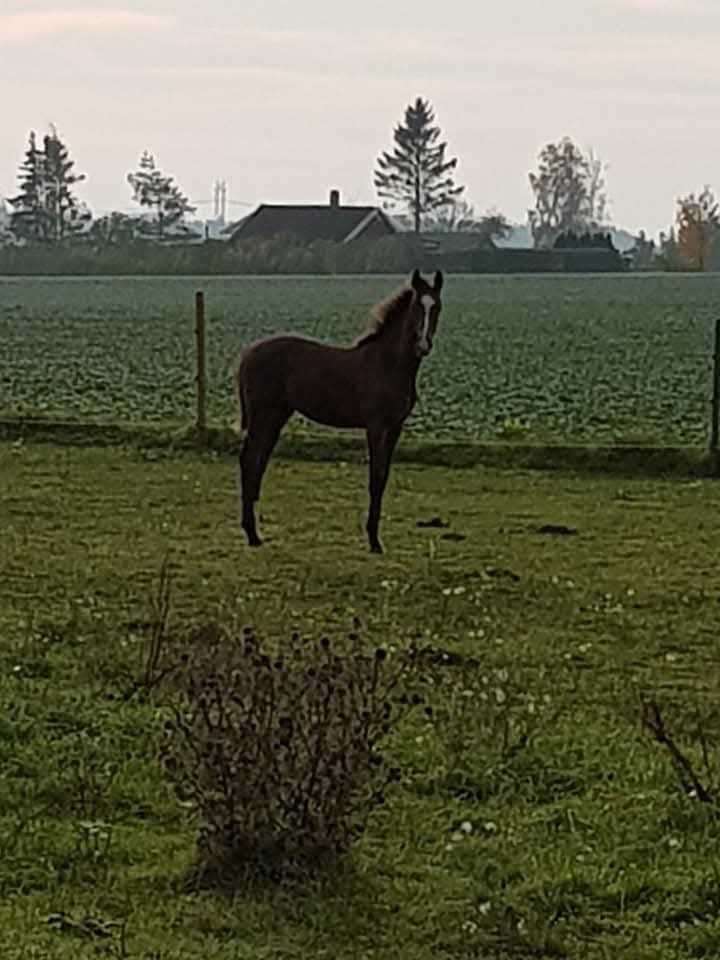
Of course, we shouldn't assume horses experience separation exactly as humans would. But research makes it clear that weaning can affect more than feeding behaviour. Studies have observed changes in calling, movement, rest, and physiological measures such as cortisol, a hormone involved in the body's stress response.
The extent of these changes varies between horses and management methods.
What I find particularly interesting is that a foal's visible behaviour doesn't always tell us the whole story. A foal who calls loudly is clearly communicating something. But a quiet foal isn't necessarily completely unaffected. That doesn't mean we should worry about every little movement or spend the first night analysing every mouthful of hay.
It means we should pay attention to the bigger picture.
Is she eating? Resting? Interacting with the other horses? Behaving in a way that's reasonably familiar for her?
Our responsibility as breeders is to make the transition as manageable as we reasonably can for both mare and foal.
Gradual or abrupt weaning: does the method really matter?
Traditionally, many foals have been weaned by removing the mare, or moving the foal, on a particular day. It's straightforward from a management perspective, especially on larger breeding establishments. But that doesn't necessarily mean it's the easiest approach for the horses.
Researchers have compared this type of abrupt separation with methods that allow the mare and foal to become accustomed to spending time apart before the final separation. And the results give us something useful to consider.
What happens with abrupt weaning?
With abrupt weaning, the mare and foal are separated without a structured period of preparation. For the foal, that can mean losing access to nursing and maternal contact at the same time.
Some foals respond with increased calling or movement. Others appear more settled. The environment, companions and individual horse all influence what happens.
It's important to remember that abrupt separation from the mother should never become isolation from other horses.
What about gradual weaning?
Gradual methods introduce separation in stages. One approach involves progressively increasing the time mare and foal spend apart. Some structured methods use secure fence-line arrangements, allowing contact while preventing nursing.
In a 2018 study involving 34 Welsh pony foals, researchers compared abrupt separation with a programme using fence-line separation during the month before final weaning. The foals in the progressive group showed less calling and trotting, along with lower cortisol levels, on the day of final separation.
That's encouraging.
It suggests that having opportunities to become familiar with separation may make the final change less stressful. But I want to be careful here. A study involving a particular group of horses and a specific method doesn't permit us to claim that every gradual approach will work for every foal.
A wider review also found considerable variation in how weaning methods and stress are measured. We still have things to learn.
What we can take from this research is that the separation method deserves careful thought, alongside the foal's social environment.
Which method could work for your horses?
Rather than looking for a single winner, ask what you can manage safely:
Approach | Main consideration |
|---|---|
Abrupt separation | A sudden end to maternal contact. Familiar companions and close observation are especially important. |
Progressively longer separations | Requires time and attention to how both horses respond. Short handling exercises are preparation, not necessarily a complete weaning method. |
Fence-line weaning | Maintains some contact while nursing is prevented, but only if the fencing and arrangement are safe for both horses. |
Whichever approach you choose, make a plan for the mare and the foal, and arrange suitable company for the foal before the final separation.
How I prepared Disa for life without Baghira
When Disa was only a few months old, I started introducing small moments when she and Baghira weren't right beside each other.
Nothing complicated. Nothing dramatic.
From the very beginning, I spent time with Disa and Baghira in the stable box. Then I started taking Disa just outside for short grooming sessions, with her mother still nearby.
As she became more comfortable, we gradually ventured a little further. She was also allowed to explore the stable on her own, with Baghira in the box.
We spent time together in the field while Baghira was elsewhere in the field. Later, Disa joined me in the adjacent paddock for play sessions. Eventually, we started taking short walks around the barn.
And slowly, those walks became a little longer.
I didn't have a stopwatch or a schedule telling me that we should reach a certain distance by Friday. Horses are rather good at reminding us that our beautifully organised plans aren't always their priority.
Instead, I watched both of them.
If Disa was comfortable and Baghira remained settled, we could try a little more next time. If either had shown signs of distress, that would have been a reason to reconsider what I was doing.
I should also mention that Disa was quite an independent youngster. She was comfortable with me and with the other horses in the herd, which undoubtedly shaped how I approached things. She continued nursing during this period, although less frequently as she grew older. She also ate haylage, a small amount of concentrate feed for foals, and minerals each day.
These exercises were about helping Disa become comfortable with short separations, not about stopping her from nursing. The eventual weaning was different: when Baghira left, the separation was permanent. I would not equate our early handling with the specific fence-line weaning programme tested in the research.
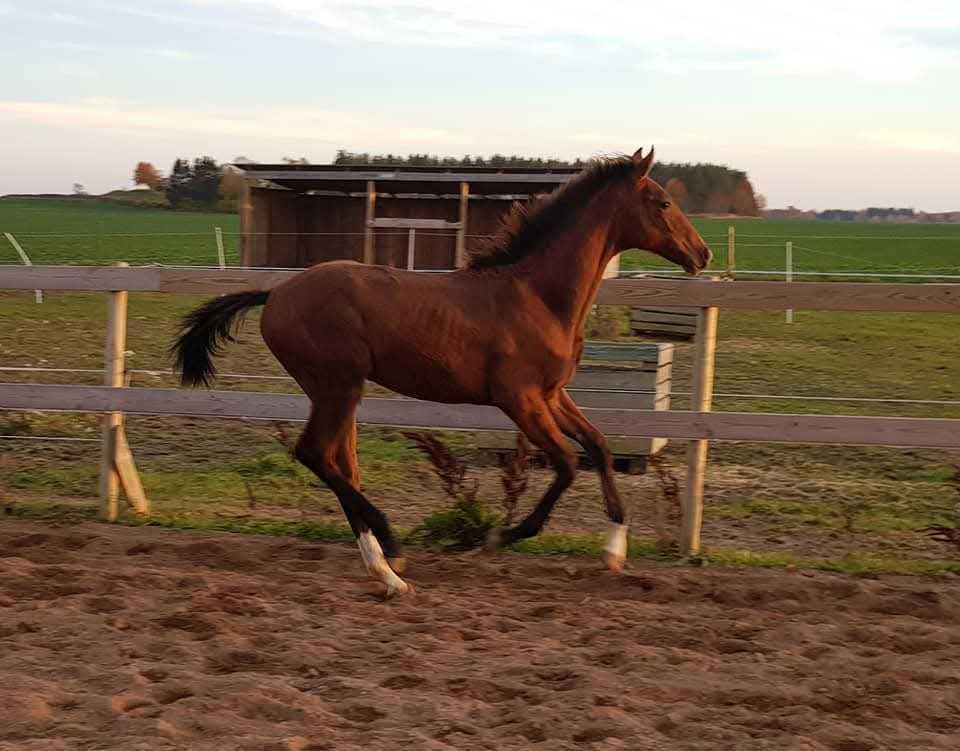
Weaning day shouldn't be the very first day your foal discovers what it feels like to be apart from her mother.
Your foal may be more or less dependent than Disa was. Your mare may find even short separations difficult. That's fine. The point isn't to have a strict routine, but to recognise that you can work with the individual horses you have. And that preparation can begin long before weaning day.
The one thing I would never compromise on: other horses
There's something I feel particularly strongly about.
A foal should not be left alone after weaning. She needs to remain part of a herd or a suitable social group with other horses.
It's worth saying that clearly, because sometimes discussions about weaning focus so heavily on separating the mare and foal that we forget what comes next.
Horses are social animals. And for a young horse, living with others is part of growing up.
Other horses provide companionship, opportunities to play, and the everyday interactions through which young horses develop social skills. We can spend hours grooming, handling, and bonding with our foals. Those experiences are valuable, and I certainly loved spending that time with Disa.
But we cannot replace other horses.
What research tells us about companionship
A 2012 study looked at whether the presence of adult horses could help reduce weaning stress. The researchers compared foals kept with other youngsters to foals kept with youngsters and unrelated adult horses. Both groups experienced some stress around weaning, but the foals with adult companions showed less pronounced and shorter-lasting responses on several measures.
That is a fascinating finding, particularly because it reminds us that weaning is not only about who leaves. It's also about who stays.
Research: Henry et al. (2012), Adults may be used to alleviate weaning stress in domestic foals.
Of course, you can't simply put a foal in a field with any adult horse and assume they'll become best friends. Companions need to be suitable, introductions should be managed carefully, and the horses need enough space and access to resources.
Ideally, the foal already knows the group she will remain with before her mother leaves.
And if she's stabled at night, think about what social contact is available there too. Having a box to herself is one thing. Being shut away without meaningful contact with other horses is something else entirely.
If you haven't yet worked out where your foal will live, and with whom, after weaning, start there.
Preparing for weaning day without making it more complicated than necessary
Once you've decided when and how to wean, the next step is to make the practical arrangements. We can't control exactly how our horses will respond, but we can avoid adding unnecessary changes. A foal whose mother leaves on the same day she moves yards, meets unfamiliar horses and changes feed has a great deal to adjust to. Where possible, I'd keep the surroundings, routine and companions familiar.
Three things worth arranging beforehand
1. Know where both horses will be.
Will the mare move away? Will the foal remain in her familiar field or stable? If you're using fence-line separation, is the fencing genuinely suitable for that purpose?
Consider how both horses may respond, not only the practical convenience of the arrangement.
2. Make sure the foal's companions are already part of her world.
A settled group of compatible horses can provide continuity when her mother leaves. If introductions are needed, plan them separately and safely rather than leaving everything until weaning day.
3. Check feeding, facilities and supervision.
Your foal should already be eating suitable forage and have an appropriate nutritional plan for growth. Make sure she can reach feed and water without being pushed away by other horses.
Check gates, fences and stable arrangements, and make sure someone can observe the horses.
If you're uncertain about nutrition, ask your veterinarian or a qualified equine nutritionist to help you assess the ration. Growing horses have particular needs, and what works for one foal may not be appropriate for another.
The trick is asking these questions while there's still time to act on the answers.
What happened when Baghira left
Baghira was a mare I had borrowed for breeding, so when the time came, she returned to her owner. As I mentioned, I'd spent months gradually familiarising Disa and Baghira with short separations, but this was of course different.
This time, Baghira wasn't coming back.
I was told that Baghira called a little during the trailer journey, but that there were no serious complications. She was a wonderfully caring mother, and I suspect the separation may still have been stressful for her.
I wasn't there afterwards, so I can't say exactly how she experienced it.
With Disa, what I remember most is a very small detail.
Baghira left in the early afternoon, and I did not notice any stress reactions with Disa. I can't know what Disa understood about Baghira leaving. However, when she got in from the field that evening, she seemed a little surprised to have the entire stable box to herself. She ate normally, and I didn't observe calling or other obvious signs of distress. But I could tell that something was different for her.
It was almost as though she was wondering where her mother had gone.
I don't want to romanticise that moment or pretend I know what was going through her mind. And I certainly wouldn't say that she experienced no stress simply because she was quiet.
But she continued her normal routines, and from what I could observe, she coped well with the change. Disa stayed in her safe environment and had the familiarity of the other horses and me. Her world was changing, but it hadn't suddenly become empty.
I believe that familiarity helped her, though I can't know exactly how much.
What should you look for after weaning?
It's a good idea to watch your foal closely after separation. You know her ordinary habits, and that knowledge is valuable. Perhaps she's usually first to investigate anything new. Perhaps she likes to rest in a particular spot or has a favourite field companion.
Those familiar details give you something to compare her behaviour with.
You don't need to count every step, but pay attention to the things that tell you how she's doing.
Is she:
Eating and drinking as usual?
Resting?
Moving normally?
Interacting with her companions?
Producing manure?
Showing signs of physical discomfort?
Some calling may occur after separation. It doesn't automatically mean the entire process has gone wrong. But neither should you dismiss persistent distress or concerning changes because someone has told you that foals simply have to get used to it.
If your foal stops eating or drinking, shows signs of colic, becomes unusually lethargic, or behaves in a way that seriously concerns you, contact your veterinarian.
And remember that the first few hours aren't the whole story. Continue observing in the following days. The goal is to understand how your foal is adjusting, not measure her against somebody else's youngster.
And what about the mare?
It's surprisingly easy to spend so much time thinking about the foal that the mare becomes an afterthought. But she has her own adjustments to make.
If she is still producing milk, the sudden end of nursing can leave her udder full or uncomfortable while production decreases. Keep an eye on her appetite, behaviour, body condition and udder health.
If the udder becomes hot, painful or markedly swollen, or the mare seems unwell, contact your veterinarian. Mastitis is uncommon but can occur as milk production is winding down; signs may include fever or abnormal milk as well as udder pain. Her feed may also need reviewing as her nutritional demands change.
Avoid improvising treatments or expressing milk routinely without veterinary advice. For practical guidance on post-weaning care, see the MSD Veterinary Manual's explanation of mastitis in horses and Extension Horses' guidance on weaning and managing weanlings. And remember that an attentive mare may respond emotionally or behaviourally to separation.
Baghira was an exceptional mother. The fact that Disa appeared to adjust quietly doesn't tell us everything about Baghira's experience.
Both horses deserve our attention.
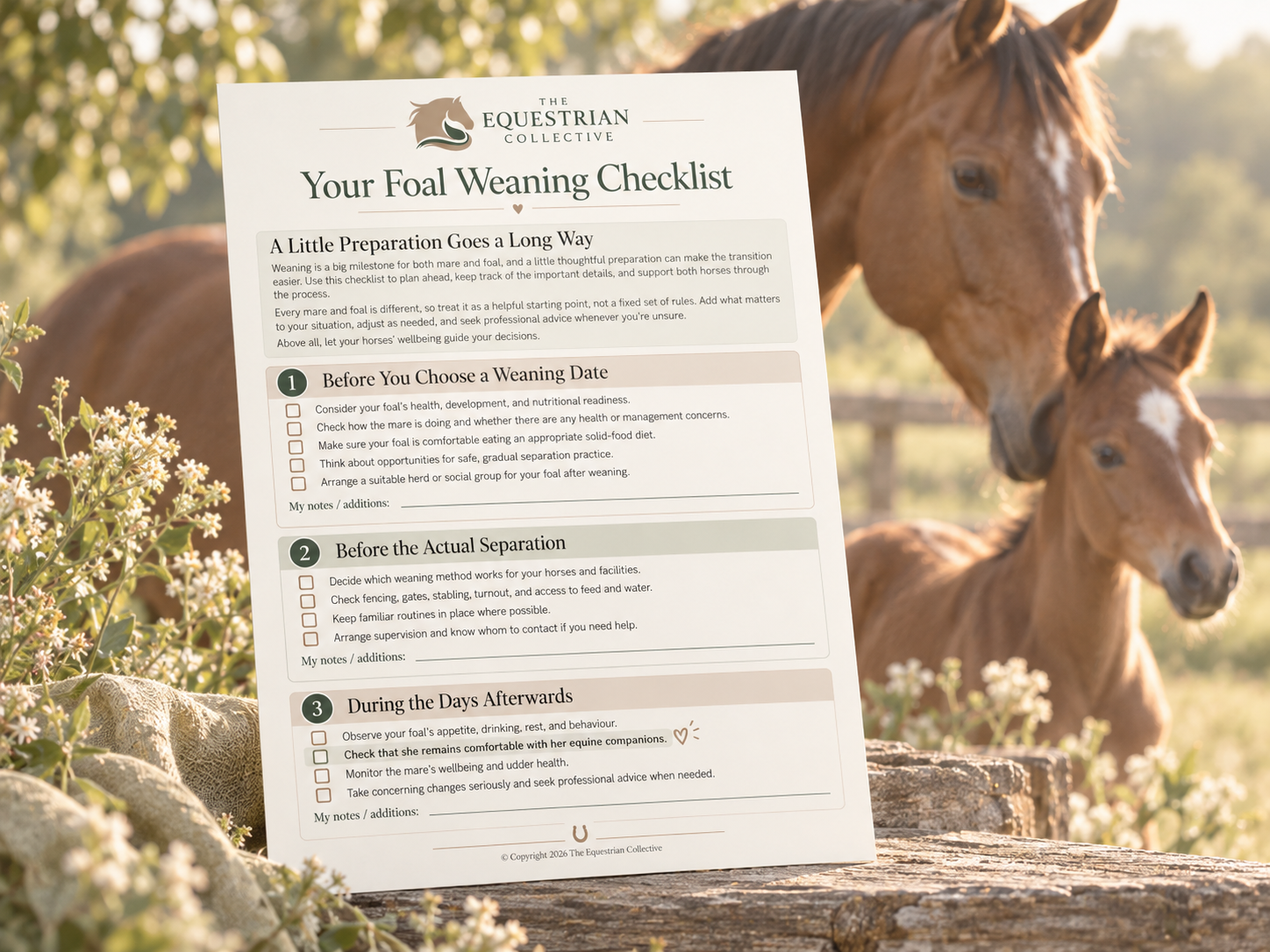
Your foal weaning plan: a simple checklist
Here's a simple way to organise your plan.
Before you choose a weaning date
Consider your foal's health, development and nutritional readiness.
Check how the mare is doing and whether there are any health or management concerns.
Make sure your foal is comfortable eating an appropriate solid-food diet.
Think about opportunities for safe, gradual separation practice.
Arrange a suitable herd or social group for your foal after weaning.
Before the actual separation
Decide which weaning method works for your horses and facilities.
Check fencing, gates, stabling, turnout and access to feed and water.
Keep familiar routines in place where possible.
Arrange supervision and know whom to contact if you need help.
During the days afterwards
Observe your foal's appetite, drinking, rest and behaviour.
Check that she remains comfortable with her equine companions.
Monitor the mare's wellbeing and udder health.
Take concerning changes seriously and seek professional advice when needed.
You may adjust the details to suit your circumstances. The important thing is to have thought them through before the day arrives.
Download your free foal weaning checklist here.
A little preparation can make a big difference
You can't predict exactly how your mare and foal will react. But you can understand their needs, prepare suitable conditions and make a thoughtful plan.
For me, preparing Disa gradually was a positive experience. I enjoyed those little grooming sessions, the time we spent together in the paddock, our walks, and watching her become increasingly independent.
They were small moments that slowly grew into a much bigger transition.
And that's something I loved about raising Disa. So much of what matters happened in those everyday interactions, long before the day Baghira left the stable.
Give your foal the chance to grow in confidence, make sure she has the company of other horses, and let her individual needs guide your decisions.
There will always be things we can't control, but thorough preparation helps us take care of the things we can.
Use my Foal Weaning Checklist to support you in your preparations.
Planning your first foal?
If you're still at the beginning of your breeding journey, there are plenty of decisions ahead, from choosing the right stallion to preparing for foaling and everything that comes afterwards.
My free Breeding Journey Workbook helps you start organising your thoughts and plan with greater clarity.
You don't have to figure out the entire journey today. Start with the decisions in front of you.
Download your free Breeding Journey Workbook here
Frequently asked questions about foal weaning
At what age should you wean a foal?
Many domestically bred foals are weaned at around four to six months, but this is a common practice rather than a universal ideal. Consider your foal's nutritional and social development, health, the mare's condition, and the arrangements you can provide before choosing a date. Personally, I would not recommend weaning before six months.
Is gradual weaning better than abrupt weaning?
Some research has found lower behavioural and physiological stress responses in foals that experienced progressive separation before final weaning. However, the results depend on the method and circumstances, and gradual weaning doesn't guarantee that every foal will experience less stress. Based on my experience with Disa, I favour gentle preparation and a gradual approach where it is safe and practical, while recognising that our early exercises were not the same as a formal fence-line weaning programme.
Can a foal live alone after weaning?
No. A foal should have suitable equine companionship after weaning, ideally as part of a stable, compatible herd or social group, preferably with horses she already knows and feels comfortable around. Her need for equine companionship does not end after the first few months. Human attention is valuable, but it does not replace social contact with other horses.
Is it normal for a foal to call after separation?
Yes, but every foal is different. Some foals call more when separated from their mothers, while others show fewer obvious signs. Calling alone doesn't tell you how well a foal is coping. Look at appetite, rest, health and social behaviour too.
Should the mare and foal still be able to see each other?
Some gradual methods allow fence-line contact, while others involve complete separation. The right arrangement depends on your horses, the method, and the safety of your facilities. Regardless of maternal contact, the foal should continue living with suitable horse companions.
How long does it take a foal to settle after weaning?
There isn't one reliable timeframe for every foal. Individual behaviour, the separation method, and the social environment all play a role. Keep observing your foal rather than assuming the transition is complete after a particular number of days or weeks.
What if the mare's udder becomes swollen after weaning?
Milk production may continue for a while after nursing stops. Monitor the mare closely, and contact your veterinarian if her udder becomes particularly painful, hot, or swollen, or if she seems unwell.
Research and further reading
If you enjoy looking a little deeper into the science, these are some of the studies behind the article:
Henry et al. (2012): Adults may be used to alleviate weaning stress in domestic foals
Domestic Foal Weaning: Need for Re-Thinking Breeding Practices? (2020)
These sources examine different aspects of weaning and should be read in the context of the horses and management systems studied. For veterinary aftercare, see the MSD Veterinary Manual and Extension Horses.